Operation May Patrol: Mission Possible – Robocops on Duty in Hangzhou
03.05.2026 | 21:30 |
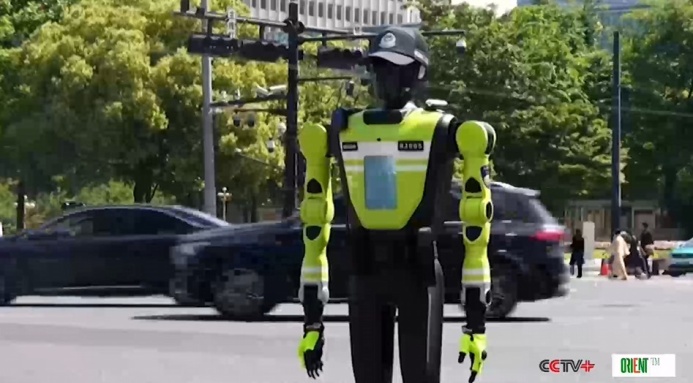


"Mission: Impossible" — that's exactly how it feels on the streets of Hangzhou right now. For the first time in China, the special assignment has gone to robot traffic controllers instead of humans. Fifteen machines — synced with traffic lights, equipped with algorithms and voice commands — have taken charge of the holiday traffic at the peak of the May Day celebrations. Tourists are stunned, violators are on notice. And managing millions of people? Mission… possible.
And here is how CCTV+ covers the story:
Ahead of the five-day May Day holidays, the scenic city of Hangzhou in Zhejiang Province on China's eastern coast is experiencing an influx of tourists, and a squad of intelligent robot traffic controllers has been deployed to help manage traffic and serve visitors.
Starting Friday, the first day of the holiday, fifteen intelligent robot traffic controllers were deployed across Hangzhou, including major tourist hubs and commercial areas.
This special "police squad", the country's first specialized unit of robot traffic controllers, aims to reduce the burden on police officers and improve the holiday experience for millions of tourists.
Pedestrians approaching the robots can interact with them through a simple touch interface. When a tourist asked for directions to the famous West Lake scenic area, the robot instantly generated a recommended route.
While assisting tourists is a visible function, the robots' primary task remains traffic management. At a busy intersection on Tiyuchang and Yan'an roads, the robots coordinated with the local traffic light control system, performing standard traffic command gestures — signaling vehicles to move, stop or turn.
A tourist said: "My first impression is how advanced this is." A local resident said: "I think this is a great idea. There are so many pedestrians here. Relying solely on human police officers would be incredibly difficult. This is exactly what a smart, technologically advanced city should look like."
Equipped with highly efficient visual recognition algorithms, the robots can identify common traffic violations, such as cyclists crossing the line at intersections or motorcyclists without helmets. When a violation is detected, the robot politely but firmly issues verbal reminders.
Traffic police officer Chen Sanchuan noted the practical advantages of the new technology. He said: "The robots can continue working after charging. They are deployed according to our actual traffic management needs. Since public transport traffic is relatively light at night, we deploy them during the morning and evening rush hours, as well as around noon when activity in nearby commercial areas peaks. They patrol the streets alongside us, helping us manage traffic more effectively."
According to Cao Lingzhi, an official from the traffic management division of the Hangzhou Public Security Bureau, the system operates on a closed-loop management protocol. He said: "We have implemented a feedback management protocol. In cases of any traffic violations that persist after three verbal reminders from the robot, the incident is automatically recorded in our internal system and uploaded to the warning and alert center of our traffic management unit. From there, our relevant squadrons conduct a secondary analysis to determine appropriate follow-up actions. After the holiday period, we plan to integrate these robots into our regular duty schedules based on operational needs."
Photo: orient.tm
Read also:

30.04.2026
|23:48

30.04.2026
|21:49

30.04.2026
|19:25


26.04.2026
|22:40

26.04.2026
|14:34