A New Era of Space Exploration: Starship V3 Prepares to Leap Toward Mars with Robots Onboard
16.01.2026 | 14:30 |


TECHNOLOGY | ORIENT. While the world remains focused on events on Earth, inside SpaceX hangars the assembly of a system destined to change human history is nearing completion. Company Vice President Kiko Donchev has officially confirmed that the first launch of the Starship V3 orbital system is scheduled for January 2026. But the real sensation lies ahead — by the end of this year, the upgraded rocket will head toward the Red Planet.
Robots Instead of Humans: The First Martian Landing
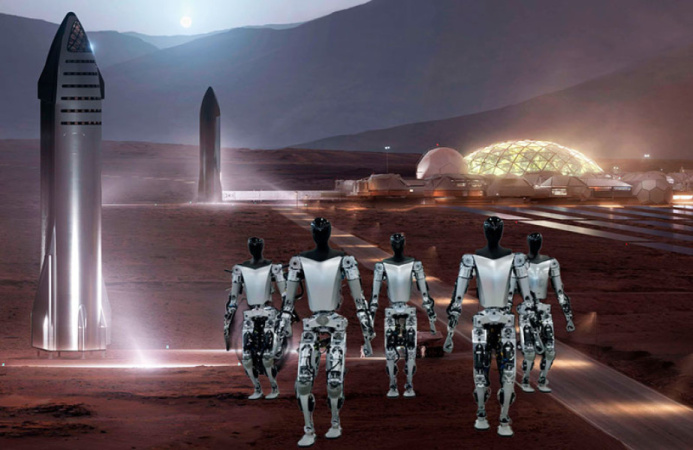
SpaceX is not merely planning a flight to Mars — it is preparing an “intelligent” payload. For the first time in history, the Starship V3 will carry a humanoid robot, Tesla Optimus, onboard.
Mission: To test the landing system under the extreme conditions of the Martian atmosphere.
Role of Optimus: The robots will serve as “pathfinders,” collecting data on gravity and climate and preparing the groundwork for future human landings.
Scale: Elon Musk plans to send a flotilla of several spacecraft to prove the reliability of the reusable heat shield technology.
Why Starship V3 Is a Breakthrough
Version V3 is not just an upgrade — it represents a radical rethinking of the entire system.
Power: The rocket will be 10–15 meters taller than its predecessors, reaching an astonishing height of 142–150 meters.
Raptor 3 Engines: The new generation of engines is simpler, lighter, and significantly more powerful, enabling the launch of over 100 tons of payload into orbit in a fully reusable configuration.
Digital Brain: The entire control and launch preparation system has been transitioned to new AI-based algorithms, allowing SpaceX to set unprecedented records.
Falcon 9 Rhythm: A Conveyor Belt to Space
The success of Starship builds upon the vast experience gained from SpaceX’s workhorse rocket, Falcon 9.
Numbers: In 2025, the company achieved a remarkable milestone by conducting more than 140 launches. The goal for 2026 is to reach a cadence of 165–170 launches, meaning SpaceX rockets could lift off from Earth every two to three days.
What Does This Mean for Us?
The launch of Starship V3 in January 2026 is more than just another test. It marks the beginning of regular interplanetary travel. If Optimus successfully steps onto Martian soil by the end of the year, human landings will become only a matter of time.
ORIENT
Photo: podolyaka.ru
Read also:

15.01.2026
|17:12


14.01.2026
|20:00